Salesforce's Agentic Era Is Here: What It Means for Your Business
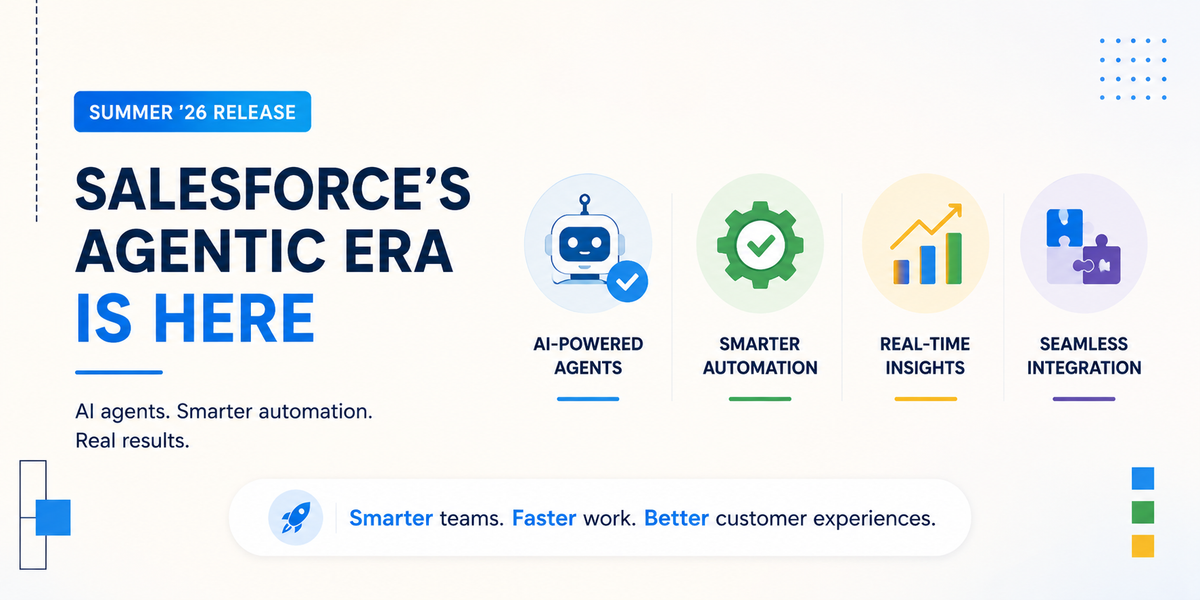
Salesforce has been steadily layering AI into its platform, but with the Spring and Summer '26 releases, the shift has become structural. The platform is now built around the idea of the Agentic Enterprise: where AI agents handle complex workflows end-to-end, not just surface recommendations for humans to act on. For businesses running Salesforce, this isn't a future vision anymore. The tools are live, the features are shipping, and the gap between early adopters and the rest is widening quickly.
Four Updates That Actually Change How Teams Work
The Spring and Summer '26 releases together represent the most significant evolution in Salesforce's platform architecture in years. Here are the four changes that matter most for business operations.
- •Multi-Agent Orchestration: Agentforce agents now work as a coordinated team, routing, executing, and closing end-to-end workflows without manual hand-offs between departments or tools. This is the headline feature of Summer '26, and it fundamentally changes what "automation" means inside Salesforce. Instead of one agent doing one task, multiple agents now collaborate across a full business process.
- •Slack-First Sales: Conversations in Slack now trigger real CRM actions, building prospect lists, updating deal stages, and sending follow-ups without reps ever leaving the chat interface. Summer '26's Slack-First Sales feature turns every conversation into a potential pipeline action, removing the friction of context-switching between tools.
- •AI-Powered Sales Workspace: Introduced in Spring '26, this unified workspace lets Agentforce research accounts, build prioritised prospect lists from web and CRM data, and surface them in both Salesforce and Slack automatically. Sales teams no longer need to manually compile account intelligence before outreach.
- •Real-Time Offer Management: Marketing teams can now deliver personalised, channel-optimised offers triggered by live customer behaviour, removing slow campaign cycles and enabling true personalisation at scale. This is a direct answer to one of the most consistent complaints we hear from marketing clients: campaigns that can't keep up with how customers actually move.
What This Actually Means for Your Implementation
These features are genuinely powerful, but they are not plug-and-play. Multi-Agent Orchestration, for example, requires clean data architecture and well-defined process ownership before agents can operate reliably. Organisations without those foundations in place will spend their time fixing data quality issues rather than activating new capabilities.
We've been working with clients across this transition, and the pattern is consistent: teams that invested in Flow architecture and data hygiene 12–18 months ago are activating Agentforce features in days. Teams that didn't are spending that time on remediation first.
Before enabling Agentforce at scale, ask your team three questions:
- •Is your lead and account data clean and consistently structured?
- •Is your existing Flow architecture documented and maintained?
- •Does your team have clear ownership of AI-agent outputs and exceptions?
The technology is ready. The question is whether your org structure is.
Choosing the Right Approach for Your Business
How you should respond to these releases depends on where your Salesforce environment stands today:
- •If you're on a mature, well-maintained org → You're likely ready to begin piloting Multi-Agent Orchestration and the AI-Powered Sales Workspace now.
- •If your data quality is inconsistent → Start with a data audit and Flow review before activating Agentforce features at scale.
- •If your team is still on manual processes → The Slack-First Sales and Real-Time Offer Management features offer a faster on-ramp with lower implementation complexity.
- •If you're evaluating Salesforce for the first time → This is the right moment; the platform's agentic capabilities are now mature enough to deliver immediate ROI.
Ready to Untangle Your Salesforce Setup?
Salesforce's direction is clear. The platform is being rebuilt around AI agents as first-class participants in business operations, not assistants, but executors. The companies best positioned for this shift are the ones building clean data foundations and clear process ownership today, not after the fact.
Reach out to us to discuss how we can help you assess your readiness, activate the right Summer '26 features for your team, and build a Salesforce environment that grows with you.